The Pale Horse
The Pale HorseThe Pale Horse is both a physical house and a deliberately misleading name: a former inn whose antique sign and occult associations lend atmosphere to a modern operation presented as a way to arrange deaths. Mark Easterbrook first hears the name as a clue to an apparently convenient service for ordinary people, then visits the house and listens to Thyrza Grey describe death through suggestion and the mind. The eventual explanation reverses that impression: the occult performance is a stalking horse, designed to direct suspicion away from the actual method.
From Inn to House
The Pale Horse is no longer a pub when Mark asks about it. Rhoda explains that it was an old inn but has become an ordinary house; Hugh Despard estimates that most of it dates from the sixteenth century. The name, rather than an active public function, preserves the building’s former identity. That distinction matters to the mystery: the place can be referred to casually as though it were a pub, while its present use is private and its historical label invites speculation.
The house’s surviving sign makes that history visible. In the low, dark hall, a twisting staircase rises beside a wide fireplace, above which the framed sign hangs. Thyrza Grey identifies it as the old inn sign, though the poor light makes it difficult to see. Ginger Corrigan offers to clean it, an ordinary act of care that briefly makes the building seem like an old home rather than a sinister establishment. The sign is therefore not just a nameplate: it anchors the house in a recognisable past, while the people associated with it give that past a new and unsettling reputation.
The building’s age is described with some variation. Thyrza Grey calls the place fifteenth-century, with parts dating to the fourteenth, while Hugh Despard places most of it in the sixteenth century. The accounts establish antiquity without providing a definitive architectural history. That uncertainty suits the house’s role: its visible age is suggestive, but the investigation cannot rely on atmosphere or inherited legend to explain what happens there.
A Name Becomes a Lead
The name first enters Mark’s attention through Poppy. During a conversation about the imagined convenience of hiring someone to remove an inconvenient person, she remarks that this could, in a way, be done, then associates the idea with The Pale Horse. Her remark is tentative and confused, not a clear explanation. Precisely because it is so incomplete, it stays with Mark. When he later asks Poppy about the name while she is arranging flowers, she drops them in surprise. Her reaction gives the casual reference greater weight than its words alone could carry.
At a later gathering, Mark asks whether The Pale Horse is another local pub. Rhoda corrects him: it is not a pub now. Hugh Despard supplies the architectural history, and Ginger Corrigan points out the framed sign; Rhoda identifies Thyrza Grey as the owner. Hugh Despard’s description of Thyrza Grey as interested in spiritualism, trances, and magic turns an old house into a possible centre of occult practice. Ginger Corrigan treats the idea playfully, imagining Thyrza Grey in a theatrical role, but Mark has already begun connecting the name with Poppy’s uneasy hint.
The clues accumulate through contrast rather than through a formal announcement. The house is called ordinary in its current use, yet the name carries an old-inn resonance; its sign is a domestic decoration, yet the owner is associated with occult practices. After meeting Thyrza Grey, Mark privately retraces the chain of events: Poppy’s remark, his inquiry about the house, and the names linked to Father Gorman’s death. He also remembers that Poppy had denied knowing of such an institution and had seemed afraid. The location becomes significant because several apparently separate strands of the investigation converge on its name.
The House and Its Occult Explanation
At The Pale Horse, Thyrza Grey offers Mark an account of magic that treats ritual as decoration around older human desires. She argues that people have long sought either love or death from sorcerers and similar figures, and that elaborate rites can dress up a more basic truth. She then shifts from historical magic to psychology, describing suggestion and the mind’s capacity to act on a person’s desire for death. These are Thyrza Grey’s claims, presented in conversation at the house; at this stage, they make the place sound like a centre of knowledge about occult influence without proving that its rites can kill.
Thyrza Grey tells Mark that she has explained so much because he understands her books and because she sometimes wants someone to talk to. She adds that she and Bella Webb have the impression that he may need them, and says Bella Webb believes he came to find them. This exchange gives the house a more active place in the investigation: it is not merely a building Mark has located, but a site whose owner interprets his arrival as purposeful. Mrs Dane Calthrop later asks why Thyrza Grey chose to tell Mark so much, raising the possibility of a particular connection without resolving it in the moment.
Mark recounts the first mention of The Pale Horse and Thyrza Grey’s explanation to Divisional Detective-Inspector Lejeune, making the house’s conversation part of the official inquiry as well as his private deductions. When Mark returns, however, the reception is strikingly conventional. Thyrza Grey wears a plain dark wool dress, opens the door in a businesslike manner, and arranges for supper straight away. Mark had expected some particular atmospheric effect; instead, the ordinary welcome unsettles the image created by the name and the talk of magic. The house’s power over the imagination depends in part on the gap between its ominous reputation and its practical, everyday appearance.
The Stalking Horse
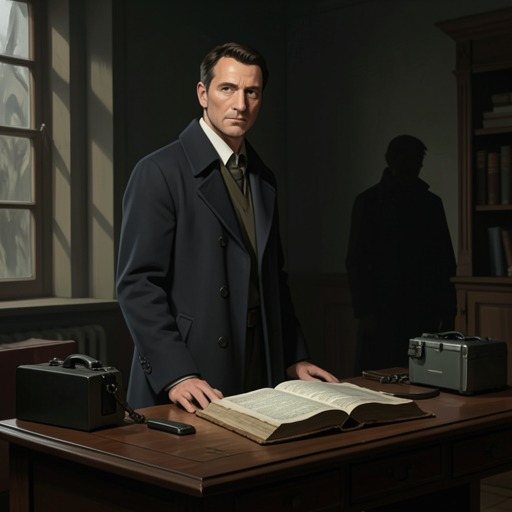
The eventual explanation recasts The Pale Horse’s occult display as deliberate misdirection. Mark concludes that the trances, white cockerels, brazier, pentagrams, and other ritual objects are staged to satisfy different kinds of credulity. The machine used in the Pale Horse ritual is likewise presented as an impressive modern device, but Mark reasons that it is harmless. The performance can appear supernatural to one audience and scientific to another, while neither interpretation reveals the real direction of the crime.
That false front is also useful because its claims are difficult to turn into a prosecutable murder method. Thyrza Grey can speak openly of occult powers, while the apparent apparatus can be examined and dismissed as nonsense. The house’s spectacle thus provides both a story for clients and a diversion for investigators: attention fixes on magic, suggestion, and a mysterious machine instead of asking what practical process is being concealed elsewhere. The location is not established as the actual instrument of killing; its importance lies in how its name and rituals organize a convincing decoy.
The Pale Horse’s meaning therefore changes as Mark’s investigation advances. It begins as the name Poppy associates with getting rid of someone, becomes a seemingly plausible address for occult services, and finally resolves into a cover story whose theatrical certainty conceals the operation’s real direction. The framed inn sign makes the old name physically present, but the house’s decisive narrative function is not historical. It is to make a modern crime look like superstition, and thereby to delay recognition of what the display is hiding.